Principals are lifting the AI governance standard across Australian heavy industry. The hard part for Primes isn't meeting that standard once — it's setting flowdown requirements that are clear enough to audit, proportionate enough that your supply chain can actually meet them, and consistent enough that your bid team doesn't rewrite the answer for every project.
Get the weight wrong in either direction and it costs you. Too heavy and your supply chain prices it back or walks away. Too light and your governance team can't attest. The right answer is a single cascade-ready spine, built once, reused across every project, and calibrated to what the National AI Plan actually requires at each tier.
Not sure what your obligations are as a Prime? Check in under 2 minutes, no email required.
The National AI Plan isn't a single regulation. It's four streams running simultaneously, each with different obligations, different timelines, and different exposure profiles depending on what your supply chain's AI is doing.
Mandatory disclosure when AI affects decisions about people. Flows to any sub whose AI touches personnel, safety classifications, or contractor assessments. Your subs need a documented disclosure position and a board-signed policy before the deadline.
Mandatory for Commonwealth agency work and flowing into state and territory contracts. Requires use case registration, accountable AI officer documentation, and AI Impact Assessments for high-risk use cases. Primes are responsible for ensuring their supply chain can meet these requirements when the project scope demands it.
The assurance framework that principals are using to set governance expectations in tender schedules. Covers state, territory, and Commonwealth projects. Your pre-qual language needs to align to it. Your subbies need to be able to answer against it.
22 asset classes now in scope. AI in operational technology is now an in-scope hazard vector under CIRMP. If your project touches critical infrastructure assets, your AI governance position needs to document the CI exposure, assess the risk, and integrate with the asset operator's CIRMP obligations.
A principal doesn't separate the Prime from the supply chain when they're scoring governance. They score the chain.
You're not just managing your own exposure across these four streams. You're managing your subbies' exposure, because their AI governance posture is now your audit surface.
Most Primes default to one of two positions when they start thinking about AI governance flowdown. Neither works.
Every sub gets the same enterprise-grade requirements regardless of what their AI does or what data it touches. The supply chain prices it back, or worse, produces documentation that ticks boxes without reducing a single real risk. Your auditor knows the difference.
No standardised requirement, no consistent evidence format, no way for your bid team to attest at the Prime level. Every tender produces a different answer and the audit finds the gaps.
The right position
Requirements scaled by what the sub's AI actually does, what data it touches, and what the project's critical infrastructure exposure is. A civil sub using AI for scheduling has different obligations to a defence sub whose AI touches personnel data. The flowdown framework makes that distinction systematically, not project by project. This is the work: calibrating the ask so it's strong enough to survive audit and proportionate enough to keep a healthy supply chain in the market.
As a Prime, your AI governance obligations operate at two levels simultaneously: your own AI use and your supply chain's AI use. Both are in scope. Both are assessed.
Your own AI use. Every AI tool your organisation uses needs to be documented, risk-rated, and approved. Your AI Ethics and Usage Policy needs to be board-signed and current. Your Privacy Act ADM disclosure position needs to be documented before December 2026. If your AI touches government work, expect to produce a completed AI Impact Assessment for every high-risk use case — agencies and principals are requiring it through contract.
Your supply chain's AI use. You are responsible for setting AI governance requirements for your subcontractors, ensuring those requirements are proportionate and achievable, and maintaining an audit trail that demonstrates your supply chain is meeting them. When a principal asks for AI governance evidence at tender, they are asking about the chain, not just the Prime.
AI Ethics and Usage Policy, board-signed and current. Privacy Act ADM disclosure position documented.
AI6 six-pillar compliance system across your own AI use. Cascade-ready flowdown requirements for your supply chain, scaled by risk tier.
Full 12-section DTA assessment for every high-risk AI use case. Required through contract on Commonwealth work, appearing in state and territory tender requirements, and expected for any AI in scope under SOCI.
Complete obligation coverage across all four regulatory streams. Cascade Response Engine for principal questionnaires and flowdown compliance. Board attestation evidence assembled automatically.
Live compliance dashboard mapped to the specific project and principal. Gap alerts before the bid team finds them. Audit trail building in real time.
The Prime Track is a single engagement that builds, configures, and deploys the full compliance infrastructure stack, calibrated to your organisation, your supply chain's risk profile, and your principal's requirements. It is not a framework delivered in a document. It is a live system left running after the engagement closes.
Step 1 — The visible entry point
$5,500 + GST · fixed scope · delivered within three weeks
A 90-minute board or ELT session plus a written brief: where your AI governance position stands against the National AI Plan, AI6, the December 2026 ADM disclosure obligations, and the flow-down clauses your principals are drafting now. Includes a gap summary across your current pockets of AI activity and a sequenced 12-month obligation map.
Priced to be approvable on a single signature. Scoped to give your leadership a defensible position — and a clear-eyed view of whether the full Prime Track is warranted.
Book the Board BriefingSupply chain governance, end to end
Build the AI governance framework your principals can score, your bid team can reuse, and your subcontractors can actually comply with. Delivered through the full pre-built infrastructure stack, configured to your project, populated during the engagement, and left running after it closes.
The point: a standard ask with room for judgement. Strong enough to survive audit. Proportionate enough to keep a healthy supply chain in the market. Built once. Reused across every project. Solvable in 90 days.
This is AI governance scoped to the National AI Plan. It complements your enterprise GRC system rather than replacing it — every register, log and evidence pack is structured to feed your existing GRC platform and audit programme.
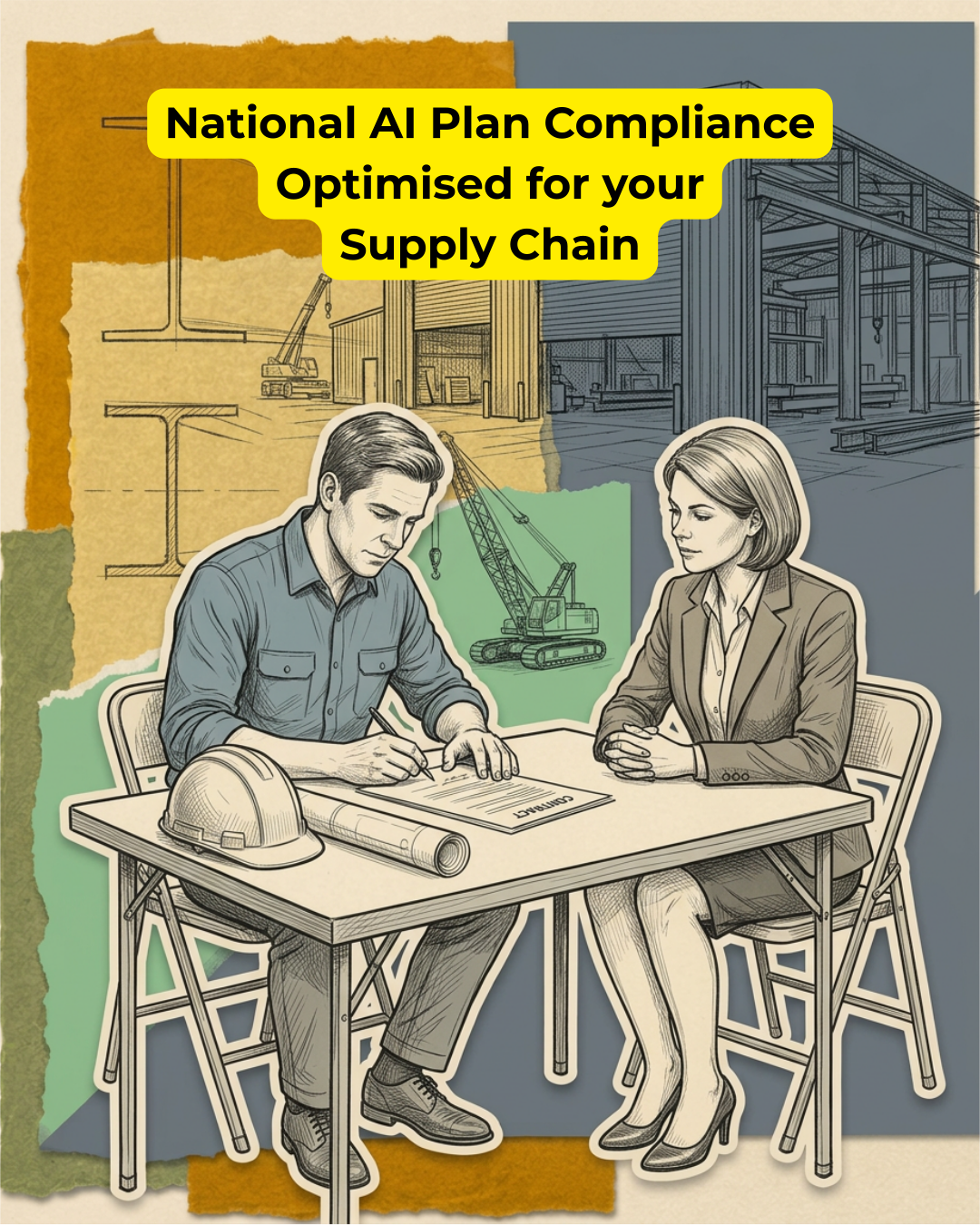
The governance spine built in the Prime Track includes a sub-contractor onboarding pack — a set of right-sized, tier-appropriate requirements your subs can adopt without each one needing a separate consultancy engagement. This is the part most Primes miss when they approach AI governance as an internal exercise.
Your supply chain's compliance posture is your audit exposure. The onboarding pack closes that loop systematically.
For subs who need more help: James works directly with sub-contractors through a dedicated Sub Track engagement. Primes who refer their supply chain to the Sub Track get a consistent evidence standard across the chain without managing the sub-contractor engagement themselves.
See the Sub-Contractor Track →The March 2026 Defence Responsible AI policy is binding, not voluntary — and it reaches your supply chain. If you hold or are bidding Defence work, your flowdown obligations are already set.
The same governance registers that satisfy the audit also give you visibility into your supply chain that monthly PDFs never could. Once the compliance infrastructure is in place and running, the data foundation is there for tools that deliver real operational value.
API-enabled subbie performance feeds replace manual reporting. Earlier signal on cost and schedule slippage. Risk flags that surface before they become variations.
Documented and defensible. A stronger pre-qual position against international competitors who can't demonstrate Australian data residency and governance controls. Where the project demands sovereign hosting — digital twins, project hubs, live progress data — it's available through Kipanga's ISO 27001 certified Australian infrastructure.
The same audit trail that satisfies the governance question also becomes the evidence base for board-level AI performance reporting. Win rate at target margin. Rework cost. Bid efficiency relative to conversion. The variables that determine whether your AI is actually delivering, not just running.
For the projects where the scope and data maturity warrant it, the governance infrastructure is the foundation. The registers, the data classification, and the access controls are already in place.
This is not a regulatory burden problem. It is a supply chain capability problem — and it is solvable in 90 days.
Thirty years directing major projects and leading business development across Oil and Gas, Defence, Energy, and Infrastructure for FTSE 100 and ASX contractors. I've architected $2B+ defence bids, led Asia Pacific strategy across seven business units and four countries for Wood PLC, and been in enough post-shortlist governance reviews to know exactly what principals are testing and what auditors are looking for.
That experience is what sits behind every flowdown decision in the Prime Track. When I say proportionate requirements, I mean proportionate to what a principal will actually score and what a sub can actually carry without pricing it back into your bid. When I say audit-ready, I mean ready for the specific conversation your governance team has when the principal asks for evidence.
The infrastructure is pre-built. The judgement behind how it's configured is not.
No innovation theatre. No enterprise overhead for its own sake. A governance position built to hold up when it needs to, and proportionate enough that your supply chain stays in the market.
★★★★★"James provides fractional support as both the Lead Account Partner and GTM Focal Point. We have a global mandate and James brings the strategic clarity and industry depth to operate at that level."
★★★★★"Working alongside James, I was always impressed by his tenacity in getting after opportunities and his rigorous approach to ensuring outcomes were achieved."
★★★★★"He led our AsiaPac Strategy process, focused on growth and diversification. Thanks to his unique knowledge across the region and industry, he was invaluable — delivering exactly what we needed."
★★★★★"We knew little about AI previously, except we were falling behind. The pilot process was easy, we learned a lot, and the AI agent has everyone excited. We are now developing our AI Scaling Strategy with James."
Possibly not from scratch, but almost certainly for the supply chain layer and the regulatory alignment. Most internal frameworks were built before the National AI Plan, the Privacy Act ADM amendments, and the SOCI CIRMP AI in-scope determination. The readiness audit tells you exactly where your existing framework holds and where the gaps are without assuming you need to rebuild everything.
It complements it rather than replacing it. This is AI governance scoped to the National AI Plan — every register, log and evidence pack is structured to feed your existing GRC platform and audit programme. If you're evaluating enterprise GRC tooling, that's a separate decision; the outputs here slot into whichever platform your governance team runs.
That's the calibration work. The Prime Track builds risk-tiered requirements, so a Tier 3 civil sub using AI for scheduling gets a proportionate standard, not the same requirements as a defence sub whose AI touches personnel data. Getting that tiering right is what keeps your supply chain in the market while your governance position holds up under audit.
The tender response pack is one of the first outputs of the engagement. You don't need the full system in place to have a defensible tender response — you need a documented position and a credible implementation plan. We build that position first so your bid team has something to work with while the system is being completed.
The sub onboarding pack is tiered precisely for this reason. Subs with no existing governance get a minimum viable standard they can meet in five days. Subs with more mature systems get a more detailed requirement. Both produce an evidence format your governance team can assess consistently. For subs who need hands-on help, the Sub Track engagement is available.
90 days is the headline. The sequence is Layer 1 and 2 first, typically weeks one through four. Layer 3 runs in parallel for any triggered use cases, typically weeks two through six. Layer 4 and 5 build on the data from the first three layers, typically weeks five through twelve. The tender response pack is available from week two. TenderPulse is live from week four.
The systems are yours. The dashboards run. The registers are maintained by your team. Annual re-attestation triggers are built in. James is available for check-ins, new tender support, and scope additions as your project pipeline changes, but none of that is mandatory or ongoing.
Yes — for active tender situations the engagement sequence can be compressed. The Tender AI Response engagement covers the immediate submission while the full system is built in parallel. Scope and timeline are covered in the scoping call.
A 20-minute scoping call covers your specific obligation profile across the four NAIP streams, what the Prime Track engagement looks like for your organisation and supply chain, what the 90-day sequence involves, and what it costs. If you're not ready for a call yet, the compliance check tool tells you your obligation tier in under 2 minutes.