
Your client's tender just asked about AI governance. Your principal wants to know about data residency. Someone in your leadership team has forwarded an article saying sovereign AI is now mandatory for critical infrastructure work.
So what do you actually have to do?
The honest answer: it depends entirely on who your client is, what data you're handling, and which specific rule applies to you. The market commentary is treating this as a binary — either you're sovereign or you're non-compliant. That's not accurate. Acting on it without understanding your actual exposure will either cost you unnecessary margin or leave a genuine risk undocumented.
Here's a plain-English breakdown.
If your client is an Australian Government agency handling sensitive data
This is as close to a mandate as exists in Australian law right now. The Hosting Certification Framework and IRAP together make offshore AI processing non-viable for sensitive and PROTECTED information. If you're supplying AI-enabled services into that environment, sovereign, on-shore deployment is your baseline — not a preference, not a nice-to-have.
If you're a defence contractor working under DISP
Same conclusion. Security classification requirements and IRAP obligations rule out offshore processing for work touching classified or sensitive material. Sovereign deployment is where you start.
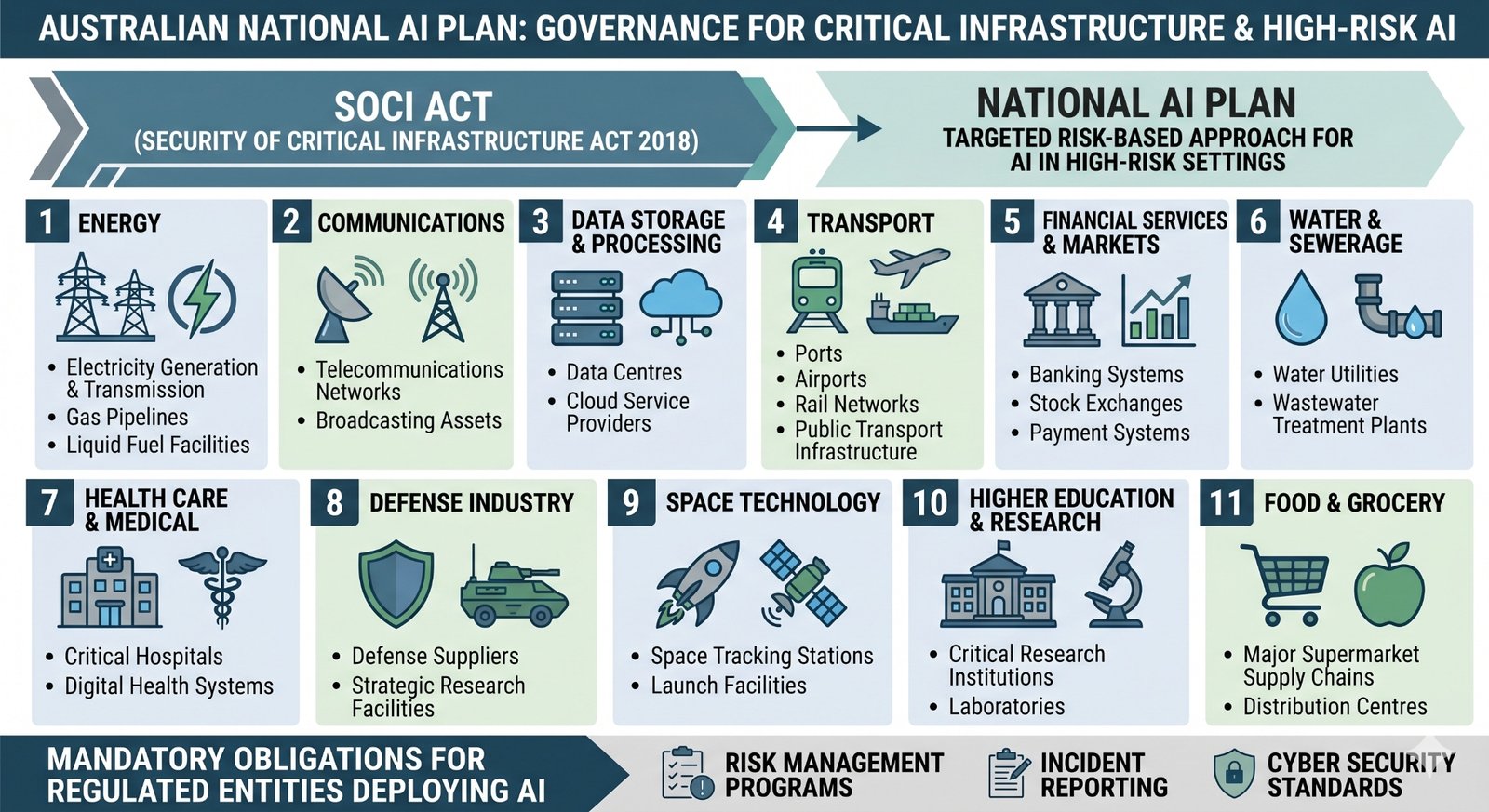
If you're a private sector critical infrastructure operator — energy, water, transport, health
This is where the binary narrative falls apart. Your obligation under the Security of Critical Infrastructure (SOCI) Act is to manage the risk of your AI architecture — not to mandate a specific one. An offshore or cloud-based system is not automatically a problem. What it creates is a supply chain risk that must be documented, mitigated, and approved within your board's risk appetite through your Critical Infrastructure Risk Management Program (CIRMP).
A Tier 1 energy company with enterprise systems centralised offshore and a well-documented CIRMP is more compliant than one with a sovereign cloud setup and no CIRMP at all. The regulator wants evidence that you understand the risk. It does not prescribe the architecture.
If you're a Prime contractor supplying AI-enabled services to a government agency
Your exposure is real but specific. The APS AI Plan requires you to tell your government customer where AI is being used in delivery of your services, and to accept contractual responsibility for that use. Your data residency obligations flow from your client's contract terms — not from a standalone law that applies to you directly. Read your contract. That's where the obligation is.
If you're a sub-contractor in a heavy industry supply chain
Regulatory obligations don't flow to you directly — they flow through your Prime's contract terms. If your head contractor has committed their client to AI governance standards, expect those requirements to start appearing in your sub-contract conditions. They're coming. But right now, they're client-driven, not universally mandated by law.
If you're using AI in safety-critical OT systems — safety monitoring, autonomous equipment, process control
Australia does not currently require formal conformity assessments for high-risk AI systems. That's the European framework. Australia has deliberately taken a different approach — building on existing standards rather than introducing a new mandatory assessment regime. The ACSC guidance on AI in operational technology environments (late 2025) is the practical baseline. Document the risk in your CIRMP and your Safety Management System. Keep an eye on whether Australia moves closer to the EU position — but don't build your compliance program around a requirement that doesn't exist yet.
If you're building or expanding data centre or AI compute infrastructure
This is the population the "sovereign AI" conversation was originally written for. The National AI Plan's Expectations for Data Centres and AI Infrastructure Developers apply directly. National interest, energy, water, workforce, and data sovereignty — all in scope. Alignment with these expectations affects how your project gets prioritised by Commonwealth regulators. Non-alignment makes your approval pathway slower and harder.
The bottom line
Sovereign AI is a genuine compliance imperative for a specific group — government agencies, defence contractors, and data centre developers. For everyone else in the heavy industry supply chain, it's a risk management question. The CIRMP is where AI architecture risk gets documented and governed, not where data residency gets mandated.
The commercial risk of the binary narrative is this: over-engineer your position and you spend money you didn't need to spend. Under-engineer it and you leave a real risk sitting outside your risk program when a regulator or client comes looking.
Neither is a good outcome on a 2% margin.
One thing worth checking before you cite it
The "Guidance for AI Adoption (GfAA)" — also referenced as "AI6" — is appearing in industry forums as an established compliance benchmark. I can't verify it against any published Australian regulatory instrument. Before you reference it in a tender or compliance document, make sure it's a real document and not a well-packaged summary of several other frameworks.
It may be legitimate. It may also be AI-generated content that sounds authoritative. Worth thirty seconds to check.
Reference points to check
- Hosting Certification Framework
- Infosec Registered Assessors Program (IRAP)
- Defence Industry Security Program (DISP)
- Security of Critical Infrastructure Act 2018 (SOCI)
- Critical Infrastructure Risk Management Program factsheet
- Policy for the responsible use of AI in government
- Australian Government Solicitor note on AI model clauses
- ACSC guidance on AI in operational technology environments
- Expectations of data centres and AI infrastructure developers
Need to work out which bucket you are in?
James Clements advises Australian heavy industry operators and contractors on AI governance, compliance positioning, and adoption strategy. Thirty years in Oil & Gas, Energy, Defence and Shipbuilding — applied to the AI challenge.
Talk through your specific situationWhich of these buckets are you sitting in — and has your principal or client started asking questions yet?